 |
| Best Counseling Degrees |
Showing posts with label dissociation. Show all posts
Showing posts with label dissociation. Show all posts
Tuesday, June 24, 2014
Sanity through Infographic: At least it's not an icepick up the nose.
When the meetings, meds and all that catharting get tired, remember it could be worse. Like, drowned in a lake to see if you'll float worse. Because crazy is *magic!* (Poof! With sparkles.) ~ The Curator

Thursday, February 20, 2014
Being Present: Someday The Screaming Will End
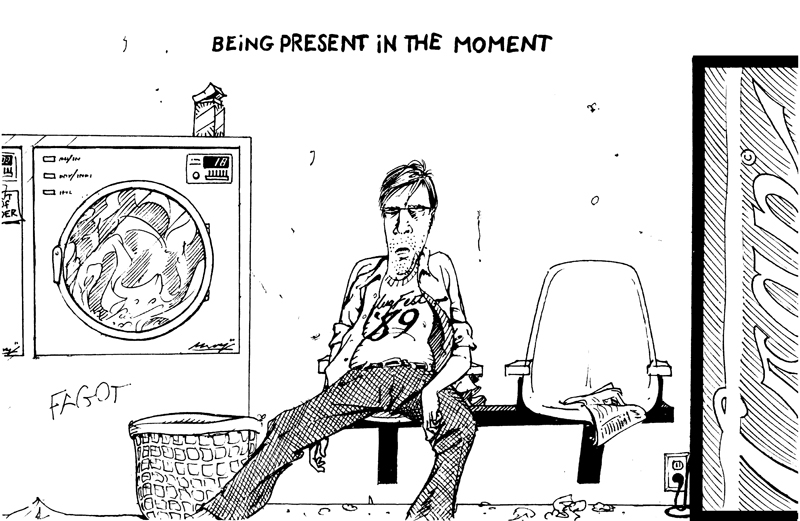 |
| "Being Present In The Moment". The Pain. |
Mode two: You try desperately to stay anchored to your sense of self and the now, feeling your breath, and focusing hard on your totem. But try as you might, you're blown out of your skin with your totem shattered to smithereens by a nuclear mushroom cloud of grief or rage that balloons inside you with infinite, unceasing energy. The memories and thoughts won't stop. After a max of ten minutes, you numb out and find yourself six hours later on your fourth pint of ice cream, your fifth bottle of Sky, your third bag of weed, your last working credit card, or fifth consecutive hour of Bioshock. You've missed a whole day of life. Because being absent felt better than being present. This is the more common option.
It sucks. When it's like this, you feel trapped. All you want is escape. You pray for freedom with desperation and shimmery puppy-dog eyes like that little girl at Christmas who just reeeaaallly wants that horse. You can feel hopeless, like your only choices are conscious torment, unconscious torture, or death. Many of us like choice three. If we ever chose it, we are grateful to have survived.
When being present is hard (splintery, shard-in-the-eye misery) like this, it's helpful (sometimes) to remember why being present matters. It's not just about noticing butterflies and bumblebees, and prancing like some blissed-out Snow White so la-dee-frickin-da happy to be alive. That's stupid. It's about finding your way out. Ending the torment.
Think of being present like holding the Maurader's Map. (Harry Potter fans, explain this.) When you pause and notice what's happening, all the paths appear. You can trace your own mental windings and dead-ends, you can follow your mental traffic. You learn your way around. You find the doors leading out.
But if you force it, crumple your map, pour Vodka or chocolate all over the paper or feed the sheet into your PS3 or bong, you ain't gonna find nothing. It stays blank (and probably silently laughs at you in some magical map kind of way, like a snarky Sorting Hat).
"Escape" through addiction or dissociation is a lie. All those blurry hours may feel like bliss, like freedom from life boiled in your own skin, but they actually trap you, simmering forever. Those silky voices luring you seductively back to your purple haze are really the voice of that skanky dealer offering you that "one last hit" from his track-marked hand. "It's just to get you over the edge so you can come down and get clean," the voice may say. And "Yeah, you can trust him," you may think. Then three weeks later you're back in the alley selling your flesh for one more hit.
Addiction, dissociation and avoidance keep you lost. They steal your map. They leave you no way out. So you're stuck there, forever. (Like Argus Filch. And who wants to be that guy?)
The only real way out is through the fire. Even when it's cat-scalding, coffee-spill-blister painful. Even when for yet another morning you have to sob-scream your way out of bed just to be able to tie your tie without strangling yourself to death.
You can get through. You can feel the feelings, think the thoughts, and get to the end of them. Every tunnel has its exit. If you just keep your eyes open and aimed at the light.
Sunday, May 26, 2013
Mental illness: Laughter in Crazytown.

Mental illness can feel like being trapped in the movie "Labyrinth." You swear you're walking straight ahead on an undeviating path. You look at the walls around you and they seem flat, sturdy and sound. Every once and a while you stop and talk to some sentient rodent who seems, while unusual, reasonable enough. Sometimes you take their queues on the way you should go. But then if you could see yourself from above, you'd know you were swirling around in an endless corkscrew of constantly shuffling walls and talking to mischievous sock-puppets operated by your own imagination.
The worst is the confusion. In your paranoia you absolutely believe, without any shadow of doubt, that klutzy barista Sharon throws scalding lobs of mocha at you in an attempt to make you feel shame. In spasms of post traumatic stress, you are entirely convinced with histrionic certainty that your assigned work shadow Brian is really orchestrating a plot to get you alone and assault you. Your disassociation invisibly splits your mind into raucous versions of "Crossfire" in which you and another you both attest with equal sincerity that you really are a Republican traditionalist who just wants to go to work, and you are also an anarchist hippie twitching to chuck all your things in a van and move to Venice Beach tonight. Then you wake up the next morning sleeping in the van in the kmart parking lot curled up on a pile of fifty cent stuffed animals and you have no idea why. (It's not as fun as it sounds.)
And don't even get me started on the medication. There are pills that give you a "safety net" but replace the whispering voices of sinister evil with a constant ringing in your ears that makes you want to bust your ear drums with booming Rastafari just to get some peace. Then there are the pills that temper your highs but make you feel like some rubberized prisoner in that moment when Ben Stein drones "Beuler. . . Beuler. . . Beuler. . . " and you can barely move your legs to escape because every part of you feels like it's swimming in lukewarm pudding. And then there are the pills that make you slightly less convinced that everyone you know wants to kill you, but simultaneously make you gain forty-two pounds and have untoward "leakage" that none of those previously murderous friends can ever discover.
Sometimes you feel your only choices are a disease that is a whirligig of interminably conflicting inputs and swings through bliss, terror and despair, and a recovery that is a parched desert of grey-tone faces, muffled voices, dulled sensations and drowsily stumbling thoughts.
Plus, without your disease, in recovery, you can feel completely un-anchored. You may have been convinced that the voice in your head, who told you your place in the mystical architecture was eternal, penitent punishment, was God's. If that voice disappears, does God vanish too? Maybe you never lived one day not impelled through frenetic busywork by mania. How do you fill your hours once you're calm?
And who do you connect with? It's not like you can just go up to the guy in the lunch room and say, "Gosh you know, sometimes it is just so hard to stop crying in the morning in time to get ready for work, right?" 'Cause it's not like he'll, perchance, just back away slowly and maybe pull the fire alarm or anything.
You feel isolated. Like it's just you, and your disease, alone on a wide grassy plain with nothing else but crickets. It's scary.
But you're not alone. A recent article showcasing three people who got better from severe schizophrenia and depression highlights that, to stay well, they:
Have fun. And connect with others.
Often, we who bear mild to extreme crazies feel as though anyone who might discover our inner Wonderland would go running screaming into the night. We can also feel excessive shame. Sometimes the only people who feel safe are those suffering like us. And there are few more healing remedies than laughing with someone about that time you taped the windows shut against night daemons, and how it's not as funny as when they nailed the door closed to keep the giants out.
Just listen to these guys:
"It is one of the blessings of old friends that you can afford to be stupid with them." ~ Ralph Waldo Emerson
"Through humor, you can soften some of the worst blows that life delivers. And once you find laughter, no matter how painful your situation might be, you can survive it." ~ Bill Cosby
"No mind is thoroughly well organized that is deficient in a sense of humor." ~ Samuel Taylor Coleridge
Some of the most ill of us are wiser, stronger and braver than the sanest of the curmudgeoney sane. Despite our struggles and brain-kinks, we can sometimes offer more to each other and the world than could someone who's survived less. And we gain huge relief from our illness when we can treat it like some cross-breed of David Bowie and a Boggart. (Just picture that for a second. Dita Von Teese? Anyone?) Our disease may never leave us. But its weight upon us and power over us will decrease significantly if we can laugh it out with friends.
Friday, May 10, 2013
Slipping: There's no such thing as fairy dust.

We all know that place. Where we teeter on the edge of the decision. To cut ourselves. Call that dealer. Drink that beer. Go back to that website. Eat that cake. It would be like sliding off a cliff. All you'd do is drift one foot leftward, and you're falling all the way down.
And at the edge you believe you're weightless. You feel no gravity, see no horizon, no earth far below. No consequences. The choice seems so easy. Restraint is so hard.
When you're trying to stay clean it can feel like you have two warring selves. One you floats at this cliff in a bliss-bubble. The other you stands outside the bubble screaming and pounding on its crystal surface like you're Dustin Hoffman trying to stop the apocalypse. You want to scramble after whatever cord powers your suspension of sanity and yank it hard with a zeeoowww that would send your other self hurtling, informed, onto the safe high ground.
But you can't. You stay stuck outside, watching helplessly as the floating you drags you both over the edge, with a blissed-out smile on its face.
Weirdly this is a learned skill.
Pain rolled over us once. To survive, we may have whipped out a mental pop-up tent into which no pain or fear could enter. We hid inside. Left reality. Dissociated.
In Coping with Trauma-Related Dissociation, psychotherapists Suzette Boon, Kathy Steele and Onno van der Hart describe some physical aspects of this strange dissociation:
"There may be times when you feel spacey, foggy, or fuzzy. You may lose a firm connection with the present without being aware of it, and only realize afterwards that you were not very present. . . . You may have times when you are aware of your actions, as though you are watching yourself, but do not feel you have control over them."They also describe dissociation's result from trauma:
"If we consider a continuum of trauma-related disorders, with post-traumatic stress disorder (PTSD) being the most basic, and developing in the aftermath of a traumatizing incident at any age, then complex dissociative disorders are a more pervasive developmental accommodation to trauma...."Trauma hits. You're shocked and scared. You hide. You fly around like Peter Pan in Wendy's sheet-bunker for hours. You try to come out, but when you do you're hit with overwhelming fear, shame and anger. So you hide more. You fly around for months, maybe years. And every time you try to emerge, "smack!" Overwhelming pain. So you never come out. And in time your hideout expands like a glowy ethereal Blob, no longer shielding only trauma but blocking every unwanted feeling or thought.
Meanwhile all that fear, shame and anger sits alone on the outside, waiting for you to come back. But you never do. And while you expand your hideout, the earth between you cracks. And the crack spreads into a cliff-edged canyon, with your two selves stuck on opposite sides, miles apart.
And then one day you find yourself all grown up (or trying to be), with that fearful, shameful, angry self boasting a 12 Step program (or two or three), and fighting hard to stay clean. But frickin Peter Pan on the other side of the canyon won't stop leaning over the edge.
So what do you do? What Peter did. Sew your fearful, shameful, angry shadow back on. And refuse to fly away.
We'll check in with Coping with Trauma-Related Dissociation again to talk about how.
Subscribe to:
Posts (Atom)