Showing posts with label abuse. Show all posts

Monday, May 13, 2013

Don't be Simon. Be Oprah: Survivor shame.

While we do grasp that we couldn't have expected ourselves to kick away the guy who jumped us in the parking lot (we're not quite Schwarzenegger in Conan the Barbarian), we still feel weak. We do get that it wasn't truly because of personal ineptitude that we received quite so many timber-jack blows from our drunken father (we were six at the time). But we still feel stupid. And yes we know it isn't necessarily true that our preborn cruelty is the great torture of our helpless mother's life (despite all her many weepings that such is so). Nevertheless, we still feel ashamed.

We accept all these rational absolutions of our guilt, in some hazy outer-region of our minds. But no absolution feels true. What feels true is this:

These extracts of rape survivors' personal shame and guilt come from Pandora's Project (a.k.a Pandy's), a resource site for rape and sexual assault survivors. Their shares are posted to show their grievous commonality and promote empathetic connection between survivors. It's as if (and I'm just guessing here) all we trauma, assault and abuse survivors are so Hulk-with-the-shirt-busting enraged about our injuries that we even hate ourselves for feeling them. We'd each gladly be rid of ourselves just to revenge ourselves on the pain we contain. Worse, we feel resonantly alone. We are too weak, too guilty, too bad to be heard. If someone knew what we'd allowed, and how we felt about it now, they'd flail backwards in disgust, throwing books and armchairs to pad their escape. They'd hate us. And their hate would confirm our self-loathing. We couldn't bare it.

But hearing that someone endured what we did, and felt as we do, makes it all seem less terrible. Seeing these people like us embraced with love, at least by someone, also mitigates our fears. Broaching our pain becomes more possible because of their example, less like a nightmare that drags us naked on our fat day to bawl "I Am Beautiful" in front of Simon Cowell off his meds, and more like a scary but doable risk.

Shame researcher Dr. BrenĂ© Brown calls this kind of empathetic, vulnerable connection the antidote to shame (if you want, skip to 2:55 for the point. Hi Oprah.):


Unfortunately, much of the time, people aren't helpful. (Don't even get me started.) Also posted on Pandy's is an excerpt from After Silence: Rape and My Journey Back that discusses how others (like, perhaps, masses everywhere) so often fail survivors (or, say, bulldoze them like Roger Rabbit under Christopher Lloyd's psychopathic glee). Also exploring this is Gift From Within, a nonprofit serving PTSD sufferers:


Effectively, survivors think something like, "Okay, even if I couldn't Arnold-sword-hack that guy off of me, or rabidly bite through dad's wrecking-ball arms, or dispel mom's mania with a tidal flood of love, at least I should stop hurting now. I should be strong now. I should be smarter, braver, better now. And everyone agrees. See how they react. They and I think this is all my fault. I wish I were dead." (Queue violent sobbing and funnel-in-throat pour of favorite drug.)

We don't deserve this. But we don't believe that. Not yet. Not without much strong, smart, brave self-love.





Wednesday, May 8, 2013

Ohio rape case special: Zombie warfare.

The news attacks with another story of kidnapping, imprisonment and rape, and our buried nightmares reanimate like zombies that will chase us bloodthirstily for a week.

First we're numb. We try to not click the news links and we palm back the zombies' lowering faces without looking. We mute the news-flashes that cut through our pretense that nothing exists in the universe besides Bruno Tonioli's hyperbolic frenzy for foxtrot, and we look straight ahead as the zombies murmur, "braains," in our ears. We dodge whispered conversations, hearing only snatches of, "It's so awful, so unbelievable. Wouldn't someone know?" and we duck into bathrooms feeling queasy, with the zombies behind us pointing back to the fading words.

By the end of the day we're twitchy. The night seems darker. The zombies trail us as we walk, seeming to move closer. Then closer.

By the end of the night we're shrieking in the tub like Janet Leigh clutching her shower curtain while dozens of zombies of all shapes and sizes pile on us to infect our brains with panoramic terror.

The world is a trigger bomb. Is there any escape?

Yes, there is.

Escape route, step one: You want to scream at those whispering people by the water cooler, "Yes these things happen! No, for the love of Albert freaking Einstein, it is not 'unbelievable'!" (strangles imaginary air-neck) "And yes, yes!, dear merciful death from above!, someone probably did know!" And then you'd kick over the whole 1982-ish Crystal Springs mechanism with a big sploosh!

This is okay. This is not wrong. Your residual trauma-related anger may be triggered and trying to work it's way out. Feel free to fantasize about various splooshings for at least a good half an hour. Maybe buy one of these. Or be like this brilliant child:


This may help you avoid actually kicking anyone in the head. That's really the main point of step one.

Escape route, step two: Your trauma memories spring from your pores like you're a Wes Craven Chia Pet and you're sort of choke-drowning in grief for those three Ohio women like one of those CGI extras in Titanic.

This is also okay. Remember, you were a victim too. Deep trauma leaves scars. And empathy is a virtue (even if it makes you like Leonardo DiCaprio who can't get on the door sometimes). You wouldn't ask those poor women in Ohio not to cry. Don't ask it of you. You can create a safe space to vent your feelings without doing harm to you or others (see brilliant child again).

Also know that (brace yourself) most enabling bystanders are scared too. Feel free to air-punch me from wherever you are for saying this. "Enablers are vampire-daemons from the Place Beyond Doom. They allow our hurt." Yes. True. But sometimes it's helpful to notice motives. Inside anyone who may have seen any strange perversity in that Ohio house, and overlooked it, is probably just another broken person who fears the truth. This could also be true for those who overlooked you. Accepting big hard truth is a feat of strength. If you can accept truth, and those around you can't, know this means you're stronger than them, and try to have mercy.

Somewhere around this daunting feeling is the general aim of step two.

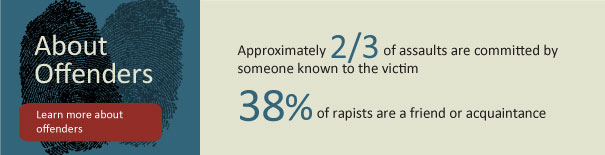
Escape route, step three: Do good with your pain. Don't let the perpetrators win by turning you into them. Don't hurt others because it will make you feel better. And maybe, if you feel strong enough, use your experience to help others. Walk back up to that water cooler (after a hearty wail-out on your car's back seat) and engage them. Tell them that one out of every four women, and four out of every one hundred men, is molested or raped at least once in their lifetime. Maybe hand them this terrifying RAINN stat sheet (perhaps emphasize the last two sections):


If the water-hoarders walk away even slightly more informed, congratulations. You've completed step three. 

Then after all of that, if you've processed the kindling-bundles of rage, fear and shame, passed through uninformed, water-starved masses everywhere, and come out the next morning okay with yourself, knowing you survived, you know truth and you do good with it, then be proud. Rick Grimes has nothing on you.


Monday, May 6, 2013

B-movie villains can't bite.

by Belathee Photography
So there is this monster that keeps attacking you. It's this four-armed, four-legged, two-headed blob of a sorta-human with two voices and four eyes each looking crazily at you from different directions. It wobbles toward you and reels back, screeching like Skylla, waving all it's arms, scaring the bumblebees out of your craptrap.

This is the person who triggers you.

He or she is this freakish conglomeration of their generally humdrum self and your worst nightmare. Flouncy Nancy in the print dress has your demeaning step-mom's face growing out of her neck. Jittery Frank in the hipster bolo has your child-molesting uncle's hirsuted arms flapping out of his coat sleeves. Nancy says, "Hi Bob," and you hear a caterwauling mixture of that and, "You ugly bastard! Nobody wants you!" Frank calls, "S'up Diana," and you get a squealing, reverbed, "You little slut."  

And usually you can't escape them. Nancy's your cube mate. Frank's your best friend's boyfriend. You're trapped. Your first impulse is to run, quit your job and dump your friend. But then your new boss is billowy Barbara with your step-mom's eyes staring out her forehead, and your sister gets engaged to chubby Charles with your uncle's drawl coming out a hole in his throat. 

The monsters keep attacking. Because they live in our heads.

Hear me out. Admitting our "trigger-monsters" aren't real is one of the scariest, hardest, most humbling recovery tasks. And one of the most healing.

It's hard because trigger-monsters feel real. We feel really attacked, just like we did back then when we were traumatized, abused, neglected, overdosed, raped. We feel cornered, demeaned and alone. Admitting the monsters' unreality feels like admitting the trauma was myth too. We feel blamed for our hurt by any implication that the triggers spring from the still-wounded crevaces of our minds. The suggestion makes us want to Bruce Lee somebody's skull.  

But the admission is also healing because it de-merges the past and present, at least a little. It's like moving a projector beam off the person blocking the screen. If you can accept that Nancy's over here, in the present, and your step-mom's face is over there, in your memory, the movie of your step-mom's screams may stop playing at you from Nancy's talking face. If you can allow that Frank just sits over there in that goofy hammock chair, and your uncle's gross arms died twelve years ago, the action sequence of your uncle's attacks could stop running in 3D surround sound. The traumatic memories may cease grabbing at you from an undulating phantasmagoria. They'll still exist. But at least Nancy will be just Nancy. Step-mom recedes back to 2D. Frank's just frank. Uncle fades to black and white. 

If the new perspective reveals Nancy as, truly, a triggeringly terrible nag, and Frank as a flirty sleaze, at least you can now deal with them as just them, and no longer space-monsters from planet Hades. And while step-mom and uncle will never be your favorite memories, their mind-daemon claws cut far less deeply from across the reach of the past. 


Sunday, May 5, 2013

Our beautiful neighbors.

When you were scared and alone that time, I bet no one saved you. Maybe someone came later, someone kind who told you they would save you, build you a rocket ship and fly you to the moon. But then they left. And you were alone and scared again.

This lingers. These childhood feelings of isolation, abandonment and threat, they stick. They sink in, pool and stain. We stay scared. We keep feeling alone and helpless. Especially when we confront scary people today.

We're at the mall with a frenemy who bosses us around, feeling our dead abuser's hands tighten around our neck, and we snap at the slow cashier. We present before our grouchy boss while our mental loudspeaker crackles out the daily rollback on our worth, and our addiction itches. 

We're trying to grow up into big, strong people who can push back and detach from scary others without hurting us or them. But we aren't there yet. Today, our "voices of truth" are stuttered grunts or scream-cries blurted out in half-fragments followed by inarticulate heaves. We lash out in preemptive emotional nuke strikes or we run away, curl into hidden balls behind chairs, hoping some big white knight will save us. But no white knight trots in.

Except for Mr. Rogers.

What? Well, he is white after all. And he does have a castle. Just watch this video....


If only he were our parents. Sigh.

Mr Rogers made this video when America recovered from 9/11. This bespectacled angel of heaven wanted to soothe our nerves and help us believe we could still look forward with hope, rather than just look back in fear, after the worst national tragedy. His message matters. Still. Today, for everyone.

Especially for we've who've suffered the worst personal tragedies.

This message matters because, first, it reminds us there are Mr. Rogers in the world. Not everyone is that grandmother who locked us in the back room for crying after being hit, nor that guy who punched us in the gut, or did worse, in the shadows of the high school bleachers.

There are plaid-tie-wearing, fake-piano-playing, walking founts of adorably safe-huggable love everywhere. Sometimes even in the people we fear.

Second, it reminds us that all these beatific Fred McFeelys (I heart you Mr. Rogers, I heart you so hard), they believe in us. They think we're good. They're proud of us, even when it seems to us that all our attempted bravery, maturity and grace end up as pretty much awkward failblog trampoline jumps into the shrubbery. They support us when we can't.

And last it matters because he's talking right to you, the little kid shrouded in a fumbly, shrieking adult body,  petrified beyond-all-get-out of the harm-sharks about to bite. And scared even more of your own helpless capacity to fail. He's speaking truth.

The past's tragedies don't define you. You have grown up (at least partly). You will "do all you can" to protect your kids (especially, ahemhem, you). You'll learn to voice truth with graceful health. And you are no longer alone.


Wednesday, May 1, 2013

Trauma Tiger: Part Two. The bully with the breastplate on.


Shame is like armor. And not that invincible spider-thread Kevlar kind of armor that could take an infrared missile to the chest and keep going. We're talking medieval armor, made out of lead, that's hot, hard-edged and heavy. It weighs you down. You try to trot around on your horse fending off invading enemies, but you just jangle crazily like your bangle-wearing grandmother driving a tank through a construction site. And your horse looks up at you with that "Dear Mother of Mercy why?" look only horses can have. 

Shame tells you it's protective. It's realism. It's clear-eyed acceptance of the sad, inevitable truth. Acceptance that will keep you ready for doom, so you're prepared. But shame is really fear. Fear pretending it's not, like that biggish kid at school who cries when his father yells at him so beats up everyone else at lunch. He's afraid to admit he's afraid, but he can't just poof! his fears away the way he wants, so instead he protests that all his fears aren't fear at all, but truth. And then he smacks you around with this "honesty": You are not afraid that you're bad. You are bad. You are not afraid of why you've been hurt. You deserve it. You are not afraid of why you've failed. You're a looser. You are not afraid of why your parents treat you the way they do. You are worthless.

Shame is fear of fear, and it cements your fears into your worldview. This kind of fear that mutates into these twisted craggy Slip-'n-Slides of self-disgust often stems from trauma, from entrenched addictions that frazzle our neural receptors, or from mental illnesses that can warp our perspectives like some cosmic string theory event. 

In Waking the Tiger: Healing Trauma (see Trauma Tiger: Part One for kicks), Peter Levine offers a good metaphor:
"When confronted with a life-threatening situation, our rational brains may become confused and override our instinctive impulses.... [It's] similar to what occurs in your car if you floor the accelerator and stomp on the brake simultaneously. The difference between the inner racing of the nervous system (engine) and the outer immobility (brake) of the body creates a forceful turbulence inside the body similar to a tornado."
So basically the "Oh my sweet carrot sticks! I'm going to die!" trauma energy gets stuck inside us and spins into a neutron bomb of terror that can't easily be "faced and conquered" without a hearty dose of Clozapine.

Addiction and mental illness are pretty much the same. Years of active addiction can reprogram the brain into thinking it's essentially gone without water for a week and a half when the abused substance is withdrawn. Addiction can also tangle emotional responses into hyper-sensitive feedback loops that spout upward into traumatically tumultuous torrents of anger or ecstasy before crashing into deep waves of depression or apathy. Likewise mental illnesses can trick sufferers into thinking they're on the brink of death every day.

The sad part is we're actually supposed to feel this way, kinda. Hear me out. Hypothetically we should be allowing ourselves to break down into these sobby panic-stricken states of universe-ending terror, so the energy creating them can flow out of our systems. This is the "not stomping on the brake" part of the process.  But we have a really hard time doing this in a way that releases control. Queue Levine:
"Many war veterans and victims of rape know this scenario only too well. They may spend months or even years talking about their experiences, reliving them, expressing their anger, fear, and sorrow, but without passing through the primitive 'immobility responses' and releasing the traumatic residual energy, they will often remain stuck in the traumatic maze and continue to experience distress."
Basically, even if we want to work through it, we want to do it with our talking, reasoning, big-kid helmets on. And if perchance we let ourselves slip over the edge into the quaking vulnerability quivering under our shielding, we get self-judgy. Al la Levine, we "tend to judge this instinctive surrender in the face of overwhelming threat as a weakness tantamount to cowardice."

And there's your shame. Fear of fear. The armor that keeps you pinned to the floor under a hot iron plate of histrionic self-loathing. And underneath it all is an adorably biggish kid who just needs to collapse.


Tuesday, April 30, 2013

Watching little girls cry.

How do you speak to someone broken by the deepest pain imaginable? What words do you pick to echo across their canyon of wounds? Can you shout over the noise of their waterfalls of grief without sounding like you're yelling? Without deserting them to merely self-comfort through paperboard platitudes, awkward jokes or the abandonment of a change of topic?

These are the questions rattling around my mind as I try to formulate a useful discussion about the treatment of victims of rape as reported in the media lately. If you don't know the recent stories, here is a summary:

Many girls and women (and boys, and sometimes men) are being been raped all over the world. In two cases, some teens and some adults reacted by not just minimizing, nor even merely blaming, but actively threatening and attacking the teenage victims. In response one young girl committed suicide. Another younger girl tried, twice.

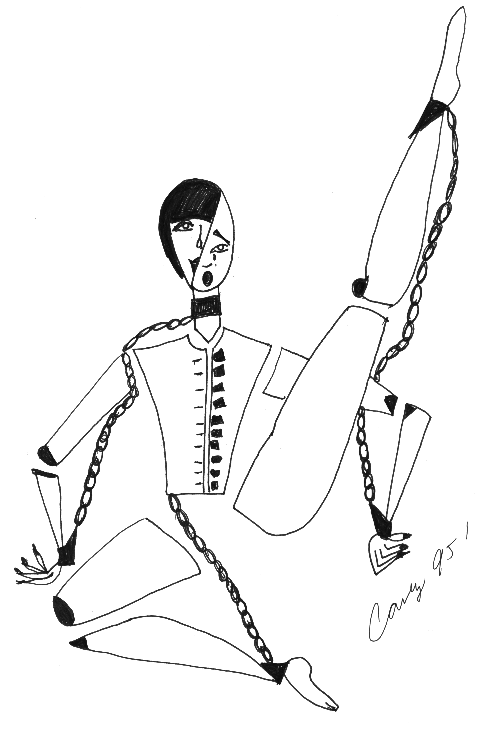
It's hard, formidably challenging, to express the depth of injury and pain caused by rape to someone who has not experienced it. Words can't frame the concept easily. This survivor art from Survivorsartfoundation.org does a good job:

Chains, Candyce Brokaw

The Infant, Leslie Kursh

Pauline in the Thorn, Rebecca Lange
If you are a victim of rape, you have probably thought about suicide. Maybe even tried it. Or you may have instead (or also) sought slow-death, like drinking yourself into liver-failure, driving drunk, shooting heroine, licking X tabs from strangers, having unprotected sex with numerous risky partners, eating compulsively into obesity, living on the streets, cutting. 

This may have been because, as soon as the rape was over, part of you immediately knew how bad it was. You knew you were on a long road. You knew your rape wasn't just a physical injury, like a bruise or cut that would quickly fade. It left a mental scar. Somewhere inside of you it created a rip that wouldn't close up. Like a skin tear, left gaping, that easily accumulates infection. 

Even if your conscious mind "left" (via unconsciousness or dissociation) your body knew, recording the attack forever. 

Clinically, rape is a trauma that triggers the animal trauma response in baser parts of the brain than the conscious mind. That trauma response, if prevented from completing (by the continuance of fear, shame or other overwhelming emotions) can lead to post traumatic stress. That stress, that tear, if left untreated over time (especially in children) can become chronic and elaborated into dissociative disorders like DID; anxiety disorders like phobias or OCD; mood disorders like depression, manic depression and rageaholism; and sexual disorders like nymphomania. Rape can severely diminish victims' capacities and quality of life for months, years, sometimes decades after the event. Sometimes for the rest of their lives.

And this is not a subject for debate. The only people questioning whether rape is harm are men who've never been raped. Their musings are about as valid as mine on the demands of dancing at the Bolshoi Ballet. 

A broader problem is society's wonderings about whether rape is really that harmful. Whether the harm done to perpetrators or those accused of perpetration with all this sorrow is, perhaps, not worse. The Onion recently ran a keen spoof video on this. This line of reasoning is, itself, very painful for victims. Victims already know, powerfully, that they alone cannot always protect themselves. When suddenly everyone in the world appears to join a perpetrator's "team," a victim can feel profoundly abandoned, helpless and vulnerable.

So why does this happen? Why do bystanders to rape so often react this way? 

Well, without writing a Wikipedia page on the topic (though it may be too late to avoid that), first (IMO) I think this happens because, ironically, people focus too much on whether harm is done. Let me explain.... If we think the severity of our crimes is dictated by the amount of harm we inflict, then we will think that if our victims haven't experienced too much harm, then our crimes aren't that bad. We don't think about us, the kind of people we are, who we are becoming.

If we stay in this line of thinking, our desire to be innocent, to avoid consequences or to shy from the discomfort of acknowledging horrific crime can naturally propel our logic into its next step.... If we are only as guilty as our victims are harmed, and if their potential lack of harm means we're not guilty, then maybe there's a way to see them as not that harmed. Maybe it really wasn't that bad. And so maybe we're not that bad. In fact, maybe they're the bad ones for telling us we are. 

And then this becomes a cultural thought.... It would be awful if people could be hurt so badly. And if people can be hurt so badly, then that means people can do terrible things. And if people can do terrible things, maybe we can do terrible things, or at least maybe we consented to them, or could have prevented them but didn't. Maybe we could have helped, but failed. But then maybe people aren't really harmed that badly, and so maybe people aren't really capable of inflicting that much harm. And if that is true, then we haven't failed to stop anything, or help anyone who really needed it. Maybe everything's okay. And in fact maybe it's the people who claim things are not okay who are really in the wrong. 

But everything is not okay. And thinking it is okay is how little girls die. 


Sunday, April 28, 2013

On how to be a giant.

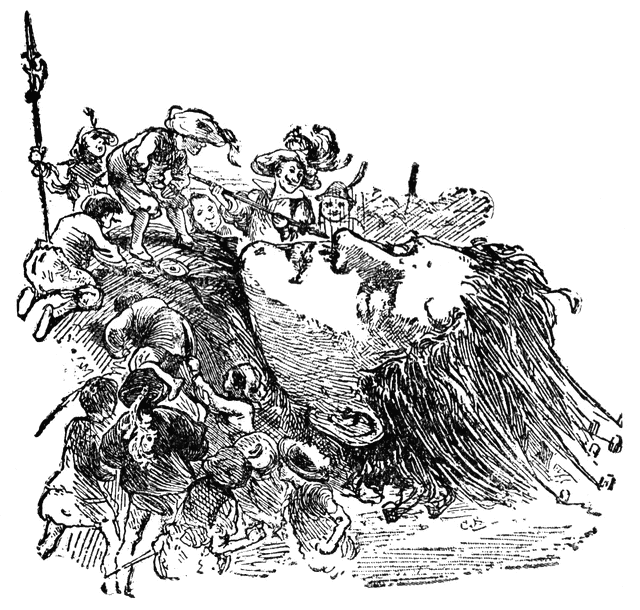
You know how, in Gulliver's Travels, the Lilliputians greet Gulliver by tying him down to the sandy beach with dozens of threads that crisscross his body and twine off little tufts of his hair? And then they crawl all over him, raid his pockets and jab tiny spears into his nose? Small people are always like that.


Yes we're all small. We all have weaknesses. We're all broken. But some of us can't admit it. Instead we get hard, like little rocks, trying to prove how big, strong, and unbreakable we are. And then weirdly our puffy, overblown bigness warps into a quashing gravity field that actually contracts us down into a more compact smallness.

Our need to be more makes us seem less. 

And this is the sad little truth about pushy, controlling, self-centered, abusive people. 

Just think of the people who've hurt you. And not exclusively those who beat you with a chair leg, used you for sex or told you what a worthless little (expletive-of-the-day) you were (everyday for seventeen years). What about those who smile when your heart breaks, sideline you so they can star and boast they're the "best" and "most" yet say not a word when you succeed. 

They're small. And you can see it. 

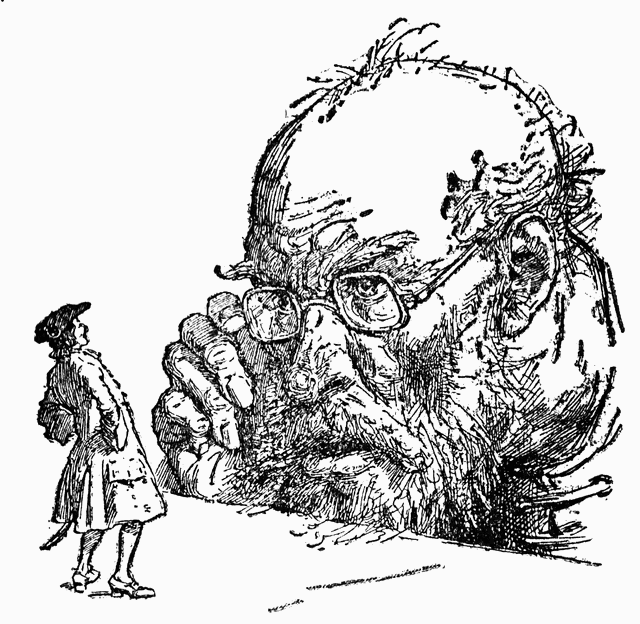
Despite that they seem enormous, panoramic in full, HD sinkhole-of-a-nose-pore obscenity, that's only because they're pushing themselves right up into your face. If you can get distance, the mental distance that Windexes your mind's eye, you can see them for what they really are.


They're little people who never grew up, never got big, and can't. So they try to make you feel small. 

And the trick to getting them out of your face? Be like Gulliver. Stand up. 


Saturday, April 27, 2013

If a victim cries in the forest.

In heaven there is a pastel air-continent where warm enswaddling blankets, soothing lullaby-like (but not Kenny G-like) music, and soft tear-soothing hands descend automatically around you when you enter. This is where you go when you've been assaulted, and admitted it, only to be disbelieved.

Denial is a cruel thing. Like medieval torture. It can often hurt as much as the assault denied.

Because deniers at least (sometimes) start off really seeming like "good people" with "values." Every time you walk around the darn corner just to buy your toothpaste you get blunderbussed by one of them, wearing a sweater vest and a smile, with Gotye Almighty instructions to forgive and forget. And who hates forgiveness, right? (Cause me, I loathe Ghandi. And Martin Luther King, Jr. Ya'll suck, you, you heroes you.) But when these generally admirable people say, "I don't believe you. That couldn't have happened," it's kinda soul-crushing.

And you know there's actually a soul-crushing process built into your lower cranium? (It's like the opposite of an emotional can-opener):

Step 1) Part of you immediately takes the noble deniers' word and retracts inward to inquisition all your pain, asking, "You got that angry? They said it's not that big a deal. You believed this happened? They said he would never do that. He loves me. What's wrong with you?"

Step 2) At the, "What's wrong with you?" stage, the question becomes a statement. And the statement gouges into your being.

Step 3) Conceding you're wrong, you start remorsefully mentally packing up all your now unacceptable hurt and outrage.

Step 4) You condense all that down with the garbage compactor of your mind into these tight little cubes of shame and fear that are magnetized to your soul for the rest of your life.

Step 5) These slowly accumulate more of themselves over time like stalagmites.

Step 6) You live on the dirty floor and can barely move or breathe.

Luckily, knowledge is power. And freedom. Just ask Frederick Douglas.

You can unclinch yourself from the vice-like grip of disbelief with deep knowledge that denial is a reaction to trauma. Hearing that a husband, son, friend (or, sigh, favorite football player) is a pedophile, wife-beater, car-jacker or terrorist is kind of a traumatic experience (except for the football player part; that's just stupid). Alright it's not like getting hit in the face with a bus, but the spontaneous demolition of (or severe injury to) a primal love can wound anyone as deep as a stab to the kidney. Just take the pitiable, grief-stricken musings of Zubeidat Tsarnaev:


While it's probably bad karma to pry too deep into her mindset (and all charges against her son are still, technically, allegations), her sad story is a good example of a prevalent problem: People will actually fail to believe what hurts too much to believe.

This sucks. But if seen clearly, it reveals that denial is not about your truth. And that's the wonderful truth.

Disbelief does not disprove the crimes denied. Nor shrivel the veracity of accusers. No one really thinks those pressure cookers were shooting red crayons.

While trauma-reaction denial does not cover all the myriad miserable ways that disbelievers let survivors down and kick us around, it does often inspire the most decades-of-therapy-and-maybe-even-a-vodoo-doll-or-two-worthy rejections. Like those from Mom, or Aunt Martha or your little brother.

Even if the entire world claims you're lying (or, at best, have False Memory Syndrome), your truth is your truth. And someone in heaven sees it.


Friday, April 26, 2013

Trauma Tiger: Part One

One of the most evil phrases ever spoken is, "Just let it go."

This erudite (and helpful!) instruction is often issued pushily by those who've never actually been gripped by the said "it" the letting go of which they propose. These pushers aren't trying to be evil (usually). They just sincerely think their experience of, say, not getting their dream first car, translates easily into your experience of being raped when you were five, or of being barfed on by your black-out drunk mom, or of being beaten with a dictionary for your whorish interest in Party of Five.

"You just have to get over these things," they might say from across the table, while you secretly shred the napkin in your lap into tiny, dismembered threads. And weep inside.

And they don't know that their (however-unintentional) suggestion that you are at least partly at fault for your pain (such suggestions are embedded at the slimy cores of all "let it go" nuggets) spirals you into compulsive fantasies of how you might feasibly get away with hitting this helpful friend in the head with a baseball bat without any baristas noticing, or hours of  scream-crying just to avoid actually acting on the violent urge.

They think their gripe equates your trauma. But it doesn't. And neither does "normie" healing equate trauma recovery.

A normie coping strategy can often be easy peasy, accomplished by saying something like, "Oh well, I guess I should focus on happier things," and followed up with a bit of retail therapy (I love Home Depot as much as the next hipster).

Trauma healing, on the other hand, is typically a scosche more complex, often featuring desperate, strung out struggles to just not geyser out random spasms of unspecified rage at the grocery store, or not shrivel up into black, cavernous hair-cloaks of self-loathing at work.

One of the best books (IMO) ever written on the unique nature of trauma healing is Peter Levine's Waking the Tiger: Healing Trauma.


In his prologue, he underscores what differentiates trauma from ordinary pains:
"...the body reacts profoundly in trauma. It tenses in readiness, braces in fear, and freezes and collapses in helpless terror. When the mind's protective reaction to overwhelm returns to normal, the body's response is also meant to normalize after the event. When this restorative process is thwarted, the effects of trauma become fixated and the person becomes traumatized."
Notice, he says here twice the body. Not the brain. Not the character. Basically, he's saying trauma is a not a head game. Healing trauma is not a mental decision. Failing to recover or recovering slowly is not a moral failing, or a sign of obstinacy. Trauma can not be disgorged at will.

Even if you've never had a bruise or a scar (though many of us have), trauma is a physical injury, something like a blown circuit breaker, or fried surge protector, or over-heated hard-drive that won't shut down squirreled away in the nooks of your hypothalamus. Healing trauma is thus also a physical process.

So let us return for kicks to the untoward table of "just let it go" despair, and flip things: Your friend feels bad because he or she can't lose weight. Well, what does any sound-minded individual say, but, "Just let it go." 

"What?" your friend asks, looking all askance at your scategorical response.

"What?" you say in reply. "Have more will power. Just let it go."

Yeah. Because will power incinerates fat internally. Just ask Susan Powter.

Assuming that fat can be evaporated at will from the lovely love-handles we all accumulate (because vegan peanut butter brownies are that nom), is as logical and kind as assuming trauma can be processed the same way. If ever anyone suggests to you that you are somehow at fault for not "letting go" hard enough ("squeeze it dammit!" they may scream), know it's not your fault. Know it's a process. A process that, ironically, just has to be let go.


Monday, April 22, 2013

Infinite brain candy.

So Mondays right? Blech. Who's tired? This one, right here, for sure.

If you're at all like me (and you know you are; don't be frightened), some days suck more than others. You know the days I'm talking about. The ones where you want to curl up like a snail in your shell, shriveling oozily into warm dreams of rotting fruit (that's what snails eat), and hoping that if your fragile, snoozy carapace is crushed by busy life as it trundles over you, at least you'll dream right through it.

That's Mondays for some, I'm guessing.

Life's hard when you're recovering. When you struggle to cope with disease, addiction, trauma, loss and pain, your insides can feel like they're cracking open, all the time, everywhere. The base of your skull can throb like a pulsar. Your trapezius muscles can seem as if they're strangling you to death. And when this break, the brokenness inside you, bleeds out like this, it can take every ounce of will and courage just to breathe spasmodically yet consistently through the shuddering breach.

And you're supposed be someplace at 9 a.m.? With a suit on? And with prepared thoughts, about things no less, things irrelevant to anything seemingly consequent, such as "Where the hockey-puck is my Prozac?" and "Why the fudge-ripple-in-a-can must I jog down the block just to smoke?"

On days like this I cling with desperation to the wisdom of "Infinity." And no this is not some new yogi mantra... though it may already be an old one. This thought-provoking painting by Jerod Kytah is a good illustration:

Infinity, watercolor, by Jerod Kytah
I like this painting because it literally shows what is meant by "the wisdom of infinity" (I like to imagine this echoing in the voice of James Earl Jones). In each of us there is a part in the shadow and a part in the light. One part hurts, really bad. And another is okay, knowing everything will be all right.

Living successfully in recovery requires cycling through these parts. Like walking. One minute you're on your left foot. Next you're on your right. You don't get very far hopping along on one foot only. If you try, you could get numb-footed, half-atrophied and, eventually, bloody-nosed.

The same goes with life. You can't thrive only in the part that's "okay," tight-fistedly rejecting any hint of the more shadowy part (or, at best, assuming the shadowier part can fix itself just fine without any uncomfortable assistance from you). Nor can you thrive only in the dark. Perpetual, purgative catharsis is no good (believe me, I've tried). Just give pulling on flowers a whirl. No matter how well-intentioned your yanking, it aint going to make them bloom.

This is where brain candy comes in (mmm yum for serotonin). We have to wash our faces, do our jobs and meet the world with some semblance of self-sustainability. There's no getting around it, unless we are blessed with a complete, financial support system. On days when our spines crack with grief and woe, our shadowier sides have hard times of this. They need help -- help that does not come in the form of self-harm (a.k.a., insert your addiction of choice here). And what better help is there I ask you than web memes that make you smile?

Buzzfeed has this good one, but it's old. So queue this adorable article I StumbledUpon this morning, listing children's definitions of love. The last is my favorite:

Author and lecturer Leo Buscaglia once talked about a contest he was asked to judge. The purpose of the contest was to find the most caring child. 

The winner was a four year old child whose next door neighbor was an elderly gentleman who had recently lost his wife. 

Upon seeing the man cry, the little boy went into the old gentleman's yard, climbed onto his lap, and just sat there. 

When his Mother asked what he had said to the neighbor, the little boy said, 

"Nothing, I just helped him cry."