Thursday, November 20, 2014

Loveburn

Collectors Quest

Love is transformative. It's beautiful and perfect. Like sunlight. It powers life. It brightens everything. It warms everything. It makes everything sparkle.

Just like sunlight, too much love can burn you.

When do you love someone too much? When you love them more than your needs, your need for friends and connections other than them, your need for emotional or financial stability, your need for safety and freedom from fear, your need for physical health. You love your kids too much when your life feels not worth living when they leave you. You love your spouse too much when you can't bear that they think anything bad about you, and you have to make them stop. You love your parents too much when you put their needs before your own or your kids'.

You love someone too much when you can't let them hurt, when you need to save them from everything, even if that means hurting and losing yourself.

You love someone too much when you can't think of anything but them. Birthdays remind you. Sundays reminds you. Grocery store aisles remind you. Movies, songs, books, pictures, colors, food, cups, necklaces, pants, carpet, sunlight, rain, snow, your calendar, what your boss said this morning, your neighbor's dog, your best friend's mom, the facebook newsfeed, the flower in the corner of the ad for return address mailing labels, everything, everywhere, always reminds you. Even when you close your eyes and all you hear is the sound of your own breath in the dark, even that reminds you.

You love someone too much when you can't forgive them for anything, because they hurt you that deeply, because you wanted that much for them to fill you up with themselves and their irreplaceable love, and they didn't. You love someone too much when you constantly expect them to change and refuse to except them and their behavior, for the same reason.

When you love someone too much, you use them, you depend on them, you need them. You can't and won't live without them, even if you wish you could and would.

That's loving someone too much.

And when you've loved someone too much so much that now your life is shriveled or even the briefest exposure burns and yet you'll stand there and soak them in, thinking, this is love, that's when you cannot love them. That's when you have to live without your light, your love, until the burn fades.


Tuesday, November 18, 2014

The grief of letting go

Image courtesy of Anna Destephano, annawrites.com.


Sometimes it doesn't work out. Sometimes people don't fit. Like mismatched puzzle pieces too bent and chewed by the family dog. Our edges are soggy, tattered, jagged.

We try "making it work," refusing to give up. We mash ourselves together into an ungainly unhinged scramble of a Thomas Kinkaid Disney castle and Guernica. We pull hard into each other's incompatibilities while they jab helplessly at our faces like Pickup Sticks in the eyes, splayed points gouging everywhere the harder we hold on. We break off each other's teeth, punch new holes in each other, and break ourselves in two, trying to make it work.

And we try to ignore this, sometimes. Even after all the damage, the self-mutilation, the shaming, the self-hatred and scourging blame of everyone including God, still we try to make this dysfunctional clash cling into a consoling whole. We see others hang together in pictures of fulfillment. They have familial love and warmth. Everything we want. And we ache.

Something like a yawning emptiness, a vacuum sucking sinkhole drops out in our heart. We hunger. It burns. It flickers with despair. And we panic. We claw and scramble away. We can't accept it. We refuse to even consider it. Surrender, "giving up," that would be a failure, loss. That would mean we're damaged, that we can't make everything right. It would be falling over the edge of that pit. If we do, we'll never get out. Nothing will ever be right again. We'll never be able to put the pieces back together.

And we'll be alone. Starving. In the dark. Forever.

Maybe it'll be our fault.

So we hate ourselves. And them, the ones we can't make fit. We try blaming ourselves. And them. We try running at them, and running away. We bargain. We do inventories. We do therapy. We plead. We pray. We do anything and everything as we scratch up and chew over and kick around every stage between ourselves and acceptance, between us and grief, that black shadow into which we cannot slip.

This does nobody any good, this aggressive denial, this refusal to accept what we cannot change. This obstinate denial that we, and they, fall into that category too. All it does is create misery. Scar us. Keep us tortured and trapped. Hating ourselves. Hating them. Blaming ourselves and bending ourselves until we break or feel half-labotomized with the pretend. We wear our spirits down, erode our souls, denying them, crushing them, until maybe they'll never fit anything ever again.

Sometimes, when you get here, to this desperate edge, all you can do -- the best you can do -- for everyone, is let go. Give in. Surrender. Fall. Sink into the black. Let grief swallow you, and trust that someday, somehow you will come up for air. After you cry and cry and cry and cry, you will land on a sunny seashore at the other side of the tunnel. You'll breathe. You'll feel warmth again. You will find love, real love. The love of acceptance, where finally, finally, you fit.

You'll fit with yourself. You'll just be you, complete.

But sometimes, you can't do this, you can't get to that free shore of self-love and self-fulfillment and health and peace, until you say goodbye.


Tuesday, June 24, 2014

Sanity through Infographic: At least it's not an icepick up the nose.

When the meetings, meds and all that catharting get tired, remember it could be worse. Like, drowned in a lake to see if you'll float worse. Because crazy is *magic!* (Poof! With sparkles.) ~ The Curator

Best Counseling Degrees

Sunday, March 2, 2014

Being Used is the Kiss of Death

Histrionic Vampires. Albernstein.com

Imagine someone jumps you. Their jaws tighten around your coronary artery. You feel blood reroute from your brain to their maw. At first, you struggle and try to scream, but you can't shake them. So eventually you go limp and stop fighting. The light gets fuzzy and pink-tinged. A strange, tingly warmth creeps over you as you start to think that spilling your life down your attacker's gullet isn't so bad after all. Maybe it's your great calling. You feel altruistic, selfless and loving, as your world goes black. Enabling an emotional vampire goes just like this.

The term "emotional vampire" is trendy, a little cruel, and overly simplistic. Unfortunately, it's also accurate. Let's demonstrate.

Back up and imagine your saber-toothed jumper is your partner, parent, sibling or friend. Let's call him or her "Vamp." Now Vamp is (probably) someone you love, or at least can't get away from. Vamp is an important part of your life and has lots of wonderful qualities you value highly. However, Vamp also has some not so good behaviors....

For starters, usually, to Vamp everything is always about Vamp. It's your birthday? Vamp wants to celebrate with five hours of stories about Vamp's latest triumphs. You're getting married? Vamp is so happy because Vamp is in a relationship too.

It's also likely Vamp can't let you have anything Vamp doesn't. You get a new car? Vamp buys a new house. You get a new watch? Vamp thinks you're so vain. You're off to Europe? How could you travel while millions starve? At least Vamp puts Feed The Children first.

More importantly, Vamp typically breathes drama. Vamp knows their boss enacts a megalomaniacal plot. Vamp is sure their cramps are septic appendicitis. Vamp's abusive checker "forced" them to hysterics at customer service and "made" them drunk-type rant Target corporate.

Therefore Vamp's life is chaos. Vamp "has to" buy all new furniture because plaid suddenly gives Vamp nightmares. Jerks should stop being judgy about how Vamp's last three cat adoptions just didn't work out. Vamp couldn't not borrow $200 grand to launch Vamp's dream ceramics shop. It wasn't Vamp's fault it closed after a month. Customers were stalking Vamp.

Mired in constant chaos (and this is the key thing) Vamp needs you. Vamp relies on you to take Vamp to the ER at 3 a.m. for that crampy (non)appendicitis. Vamp depends on you to be there for Vamp's three-hour scream-cry about that megalomaniacal boss. Vamp will feel so abandoned if you don't help Vamp haul all Vamp's old, plaid stuff out.

Should you resist Vamp, set boundaries, or do anything possibly loosening Vamp's death-chomp on you, Vamp probably won't react well. You admit your girlfriend hints at marriage. Vamp melts down and harasses the girl for being a skanky slut. You say you can't rush over to check Vamp's "probably-fractured" spine because it's 2 a.m. and you have an 8 a.m. presentation. Vamp maligns you as a selfish non-friend. You get promoted to Manhattan. Vamp accidentally cancels your flight. Then Vamp "repays" you by driving you out, where Vamp wants to live together.

Vamp can't ever -- ever -- let you go. Because to Vamp, you are a human life preserver. You keep Vamp afloat in a constant emotional storm. Unfortunately this blood-sucking smooch drowns you both.

The injuries to you are obvious. Your birthday becomes a Vampalooza. Your trip to Europe is soured by Vamp's ire. You snap at your kids after Vamp's cry-a-thon leaves you weary. You're late to your presentation after assuring that, indeed, Vamp's back is fine. You have to pay double for a new flight to New York.

Vamp's injuries are subtler. Because Vamp is an addict, and Vamp's drug is you.

"Emotional vampires" are not evil people. They're hurt ones. They're often gravely-injured, one-step-from-The-Walking-Dead ones. And they may not know it. But you probably do. That's probably why you keep giving Vamp "one more chance."

You're not healing Vamp when you let Vamp use you. When you conceal your bite-marks with fake smiles and faker forgiveness. You're killing Vamp, with kindness.

When Vamp uses you to boost Vamp's mood, reassure Vamp's insecurities, reassemble Vamp's life or fend off Vamp's fall-out, Vamps stays sick. When you "make everything okay," as Vamp spins in Vamp's whirlpool world, the hole sucking Vamp's universe down gets bigger. Your relationship becomes like the jack in a crack-addict's arm. Every hit widens the wound. And no hit ever satiates the hunger.

No matter how much love, empathy, forgiveness or energy you pour into the heart of whomever drinks your psychic life dry, it will never be enough. You will never be enough. You will never fix them. They will never feel fixed. Suck and suck and suck and they will still thirst.

Only they can fix them. Only they can fill them. And they can only find, fix and fill themselves when you're out of the way, and they face the light.


Thursday, February 20, 2014

Being Present: Someday The Screaming Will End

Generally, I find there are two main modes of being present.
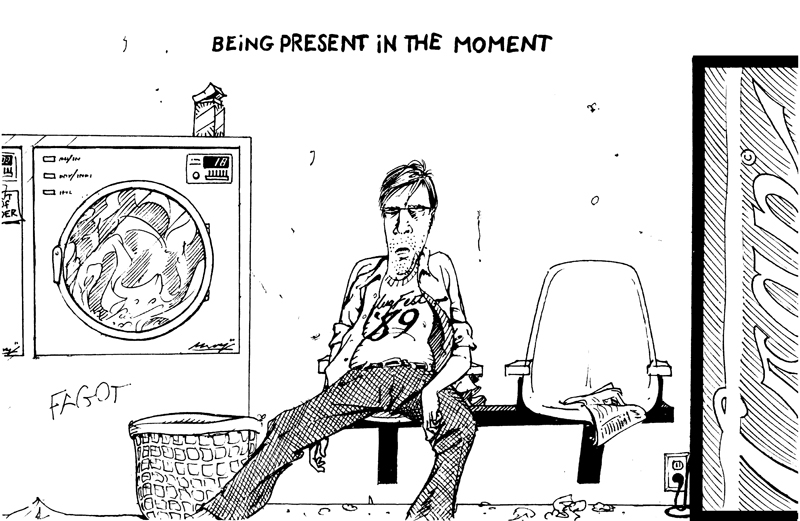
"Being Present In The Moment". The Pain.
Mode one: You wake up. You feel like crap-taffy. Your neck and lower back are all kinked up from stress that tormented half your brain with sleeplessness all night. Trying to recover, you give "noticing" the tension a whirl, and you burst into uncontrollable sobbing or a ten-minute pillow-scream before you can safely manage making coffee without scalding the cat. This is the more preferable mode.

Mode two: You try desperately to stay anchored to your sense of self and the now, feeling your breath, and focusing hard on your totem. But try as you might, you're blown out of your skin with your totem shattered to smithereens by a nuclear mushroom cloud of grief or rage that balloons inside you with infinite, unceasing energy. The memories and thoughts won't stop. After a max of ten minutes, you numb out and find yourself six hours later on your fourth pint of ice cream, your fifth bottle of Sky, your third bag of weed, your last working credit card, or fifth consecutive hour of Bioshock. You've missed a whole day of life. Because being absent felt better than being present. This is the more common option.

It sucks. When it's like this, you feel trapped. All you want is escape. You pray for freedom with desperation and shimmery puppy-dog eyes like that little girl at Christmas who just reeeaaallly wants that horse. You can feel hopeless, like your only choices are conscious torment, unconscious torture, or death. Many of us like choice three. If we ever chose it, we are grateful to have survived.

When being present is hard (splintery, shard-in-the-eye misery) like this, it's helpful (sometimes) to remember why being present matters. It's not just about noticing butterflies and bumblebees, and prancing like some blissed-out Snow White so la-dee-frickin-da happy to be alive. That's stupid. It's about finding your way out. Ending the torment.

Think of being present like holding the Maurader's Map. (Harry Potter fans, explain this.) When you pause and notice what's happening, all the paths appear. You can trace your own mental windings and dead-ends, you can follow your mental traffic. You learn your way around. You find the doors leading out.

But if you force it, crumple your map, pour Vodka or chocolate all over the paper or feed the sheet into your PS3 or bong, you ain't gonna find nothing. It stays blank (and probably silently laughs at you in some magical map kind of way, like a snarky Sorting Hat).

"Escape" through addiction or dissociation is a lie. All those blurry hours may feel like bliss, like freedom from life boiled in your own skin, but they actually trap you, simmering forever. Those silky voices luring you seductively back to your purple haze are really the voice of that skanky dealer offering you that "one last hit" from his track-marked hand. "It's just to get you over the edge so you can come down and get clean," the voice may say. And "Yeah, you can trust him," you may think. Then three weeks later you're back in the alley selling your flesh for one more hit.

Addiction, dissociation and avoidance keep you lost. They steal your map. They leave you no way out. So you're stuck there, forever. (Like Argus Filch. And who wants to be that guy?)

The only real way out is through the fire. Even when it's cat-scalding, coffee-spill-blister painful. Even when for yet another morning you have to sob-scream your way out of bed just to be able to tie your tie without strangling yourself to death.

You can get through. You can feel the feelings, think the thoughts, and get to the end of them. Every tunnel has its exit. If you just keep your eyes open and aimed at the light.

Sunday, August 4, 2013

Mental Obsessions with Mortal Enemies


And we're back from a long hiatus. Sorry about that folks. I'll try not to let it happen again.

Anyhoo, you ever find yourself obsessing endlessly about someone you dread? For example, you spend hours a day anticipating how so-and-so will soon cut you open with words, trample your boundaries, rip apart your dreams, and generally leave you a crumpled, tear-soggy, helpless mass on the floor. And you ceaselessly imagine yourself confronting whoever-they-are with irrefutable proof of their many crimes and truly decrepit moral state. And in this fantasy you always picture that your just conviction crumples their soul (just a little) and (even better) changes them so that they will never try to hurt you again.

But then you never actually do say anything -- or if you do it's a self-recriminating pre-apology for your inappropriately hurt feelings or a spasmodic scream-cry of hyperbolic rage that leaves you in the wrong. You never get your point across. You never feel better. Your relationship with dreaded so-and-so never changes. And so you obsess on and on.

This behavior is a like a twisted inverse of that phrase, "hope for the best, prepare for the worst." Instead, you're obsessing about the worst and preparing for nothing.

So what's the solution? Well, the fist step is realizing that the obsession is probably causing you much more misery than whoever-they-are probably ever could. Just think about it. How many hours a day or week or month do actually spend in so-and-so's company? And of that time, how much is actually spent receiving hurts from so-and-so, or having your boundaries crossed by them, or being subject to whatever they do that drives you up the wall? Then compare that time to how many hours a day or week a month you spend obsessing about whoever-they-are and what they've done or could do next. Think how you feel in midst of the obsession, how twisted up you are with your hurt, resentment, shame, and fear. Odds are, reality is far less painful than your preoccupation with it.

And if it hits you that your obsession, not whomever you're obsessing about, is the primary source of your pain, you will be motivated and empowered to end both.

And that's the trick: realizing what you do have power over. Because the sad truth is, even if you did muster up the courage to confront so-and-so in a reasonable and matter-of-fact way, and did say everything you wanted to say in exactly the way you wanted to say it, you're not going to change them. You have no power over them.

People have to want to change themselves. And not everyone has 12 Step Programs. Not everyone has therapy. Not all have the willingness or capacity to change.

So if our fantasies of freedom from pain hinge entirely on someone else changing their behaviors, we will likely be left miserably dependent on something that will probably never be, and forever suffering.

We have to realize that only we have power over us. Only we can change. The so-and-sos ain't gonna. So if we're afraid that the so-and-sos will rip our souls apart with vitriol or violation the next time they come around, we can consider our real options: 1) we don't have to let them around, or 2) if they do come around and start attacking or imposing, we can say, "Stop. I don't let anyone speak to/treat me that way," or something of the like. If, after that, they keep attacking or imposing, we can leave or escort them to the door.

"And how on God's green earth and we supposed to do that?!?" you may ask. To some such direct self-care sounds like super-feats the likes of which will only be seen in the next Superman-Batman team-up. There might as well be a "kapoww!!" caption over our heads when we do it, it's that likely to happen.

Yes, self-care is hard. Terrifying. But it's better than helplessness. Or endless miserable desperation. Plus, you can practice!

You can visualize what you'd say and what you'd do the next time self-care is called for. You can practice, mentally, saying the right words, responding to so-and-so in a way that makes you feel healthy and safe. And the more you mentally practice, the easier actually practicing self-care will be. No kidding. They say athletes who can't train due to injury maintain and even improve their performance by visualizing their moves over and over again. Their minds actually train for action through visualization of action. You can do the same.

Try releasing obsessive fear and anger and embracing self-responsibility and care. The worst that could happen is you'd have something else to do besides angst powerlessly about doom.

Wednesday, June 5, 2013

When you don't heal. Trauma Tiger 3.

"Putting yourself back together again." KanrieAnn
"What the crap?" we may ask ourselves when our emotional struggles persist. We go to meetings and therapy, we mediate and practice yoga, we eat only raw, vegan muesli, and consume libraries of self-help texts. But still, we're edgy and anxious, we snap at our mates and friends, we weep loudly over small hurts, and our addictions itch. Despite trying every wise and even sketchy recovery technique, we still don't feel better.

We may even be told we can't expect to feel better. All we can have is management of constant pain. In despair, we think, "Is recovery worth this? My drug really was my only comfort." Then we cruise up to our favorite bar, drive-through or pharmacy, and just look. Yearning.

But healing and freedom, they exist. The trick is knowing where to find them. (They're not in those bags, bottles and cans.) Often, they lurk behind our unresolved trauma.

I know some of you may think, with your eyes all asquint, "Trauma? I've never been traumatized. Other people are beaten, raped, have survived war or car accidents. I'm just a normal addict," or, "I've just got your run-of-the-mill dysfunction." Well, maybe.

But traumatic events are not merely happenings like, for instance, an asteroid crashing into your back patio as Bruce Willis shoots off your pinky toes while fighting radioactive snake monsters from space. Trauma really isn't an "event" at all. It's a condition. A state of being, potentially caused by any deep hurt.

In Waking the Tiger (see this and this for background), trauma psychologist Peter Levine explains it:
"The official definition [of ] trauma is that it is caused by a stressful occurrence 'that is outside the range of usual human experience, and that would be markedly distressing to almost anyone.' . . . This description is somewhat useful as a starting point, but it is also vague and misleading. Who can say what is 'outside the range of usual human experience', or 'markedly distressing to almost anyone'?" 
Some of us have been raped, shot, overdosed. We can look back to an event and say, "This is what happened. This is why I hurt." But others of us just don't know what's with us. We've never seen ourselves as "traumatized," but for a while we've felt off. Some mysterious cloud of hurt chases us. And we have tried hard to get over it. We worked our Steps, shared it in therapy, wrote letters we then burned or sent flying skyward on balloons. But still, the hurt stays. We still feel scared, angry, sad. Stuck.

These are signs of trauma. According to Levine, traumatized people can have widely various experiences that cause their injury. Surgeries, falls, the sudden loss of a parent, child or spouse, the disastrous injury of a dear friend. Anything that triggers your primal trauma response will do. The unifying thing is the symptoms:
"traumatized people. . .  are unable to overcome the anxiety of their experience. They remain overwhelmed by the event, defeated and terrified. . . . Unresolved trauma can keep us excessively cautious and inhibited, or lead us around in ever-tightening circles of dangerous reenactment, victimization, and unwise exposure to danger. We become the perpetual victims or therapy clients. Trauma can destroy the quality of our relationships and distort sexual experiences. . . . The effects of trauma can be pervasive and global or they can be subtle and elusive." 
And that's the big giveaway. Subtly or globally, we feel overwhelmed, unable to overcome. Traumatized.

Healing starts when you can accept that, if you are traumatized, your feelings are "physiological as well as psychological." Your pain, fear, sadness and anger, they aren't shortcomings. They're wounds, even if you don't know what caused them, like the inexplicable bruises and scrapes that appear on your shins somehow. And you heal them, partly, in the same way. Hear Levine:
"we all have the innate capacity to heal our traumas. . . . trauma represents animal instincts gone awry. When harnessed, these instincts can be used by the conscious mind to transform traumatic symptoms into a state of well-being."
You wouldn't pick at those seemingly spontaneous bruises and cuts, slapping them around as signs of your malignant self-pity. You'd bandage them, allowing your body to heal. Similarly the best way not to heal trauma is to try to disgorge it, blaming yourself for a "pity party" and refusing to "wallow." (If this old timer's experience is worth one nugget of truth, it's that that ain't going to work.)

What works is admitting your trauma, aiding it with as much TLC as you can muster, and helping your mind relearn health. You may need some new forms of professional assistance. But you wouldn't decline the ER in favor of an everyday band-aid if you sawed off a finger, so it's probably unwise to deprive a metaphorically bleeding brain, right?

And then, one day, if you feel better, and along the way you recalled something like, "Oh yeah, I guess that one time my grandfather did punch me in the face," or, "I guess Mom did drive away and never come back," you'll know you were never a weepy masochistic. Your hurt was never your fault. And instead of punishing it with more pain, you helped.





Sunday, May 26, 2013

Mental illness: Laughter in Crazytown.


Mental illness can feel like being trapped in the movie "Labyrinth." You swear you're walking straight ahead on an undeviating path. You look at the walls around you and they seem flat, sturdy and sound. Every once and a while you stop and talk to some sentient rodent who seems, while unusual, reasonable enough. Sometimes you take their queues on the way you should go. But then if you could see yourself from above, you'd know you were swirling around in an endless corkscrew of constantly shuffling walls and talking to mischievous sock-puppets operated by your own imagination.

The worst is the confusion. In your paranoia you absolutely believe, without any shadow of doubt, that klutzy barista Sharon throws scalding lobs of mocha at you in an attempt to make you feel shame. In spasms of post traumatic stress, you are entirely convinced with histrionic certainty that your assigned work shadow Brian is really orchestrating a plot to get you alone and assault you. Your disassociation invisibly splits your mind into raucous versions of "Crossfire" in which you and another you both attest with equal sincerity that you really are a Republican traditionalist who just wants to go to work, and you are also an anarchist hippie twitching to chuck all your things in a van and move to Venice Beach tonight. Then you wake up the next morning sleeping in the van in the kmart parking lot curled up on a pile of fifty cent stuffed animals and you have no idea why. (It's not as fun as it sounds.)

And don't even get me started on the medication. There are pills that give you a "safety net" but replace the whispering voices of sinister evil with a constant ringing in your ears that makes you want to bust your ear drums with booming Rastafari just to get some peace. Then there are the pills that temper your highs but make you feel like some rubberized prisoner in that moment when Ben Stein drones "Beuler. . .  Beuler. . .  Beuler. . . " and you can barely move your legs to escape because every part of you feels like it's swimming in lukewarm pudding. And then there are the pills that make you slightly less convinced that everyone you know wants to kill you, but simultaneously make you gain forty-two pounds and have untoward "leakage" that none of those previously murderous friends can ever discover.

Sometimes you feel your only choices are a disease that is a whirligig of interminably conflicting inputs and swings through bliss, terror and despair, and a recovery that is a parched desert of grey-tone faces,  muffled voices, dulled sensations and drowsily stumbling thoughts.

Plus, without your disease, in recovery, you can feel completely un-anchored. You may have been convinced that the voice in your head, who told you your place in the mystical architecture was eternal, penitent punishment, was God's. If that voice disappears, does God vanish too? Maybe you never lived one day not impelled through frenetic busywork by mania. How do you fill your hours once you're calm?

And who do you connect with? It's not like you can just go up to the guy in the lunch room and say, "Gosh you know, sometimes it is just so hard to stop crying in the morning in time to get ready for work, right?" 'Cause it's not like he'll, perchance, just back away slowly and maybe pull the fire alarm or anything.

You feel isolated. Like it's just you, and your disease, alone on a wide grassy plain with nothing else but crickets. It's scary.

But you're not alone. A recent article showcasing three people who got better from severe schizophrenia and depression highlights that, to stay well, they:

Have fun. And connect with others.


Often, we who bear mild to extreme crazies feel as though anyone who might discover our inner Wonderland would go running screaming into the night. We can also feel excessive shame. Sometimes the only people who feel safe are those suffering like us. And there are few more healing remedies than laughing with someone about that time you taped the windows shut against night daemons, and how it's not as funny as when they nailed the door closed to keep the giants out.

Just listen to these guys:


"It is one of the blessings of old friends that you can afford to be stupid with them." ~ Ralph Waldo Emerson


"Through humor, you can soften some of the worst blows that life delivers. And once you find laughter, no matter how painful your situation might be, you can survive it." ~ Bill Cosby


"No mind is thoroughly well organized that is deficient in a sense of humor." ~ Samuel Taylor Coleridge


Some of the most ill of us are wiser, stronger and braver than the sanest of the curmudgeoney sane. Despite our struggles and brain-kinks, we can sometimes offer more to each other and the world than could someone who's survived less. And we gain huge relief from our illness when we can treat it like some cross-breed of David Bowie and a Boggart. (Just picture that for a second. Dita Von Teese? Anyone?) Our disease may never leave us. But its weight upon us and power over us will decrease significantly if we can laugh it out with friends. 


Monday, May 20, 2013

Addiction gypsies steal your brain.

The addiction gypsies sneak up behind the focused, recovering addict. The Victoria & Albert Museum
You know that "follow the cup" game where you mentally track a concealed ball being shuffled around by a Fagin-ey hustler? And as you stand there tracking the ball, his two gypsy kids sneak up, saw the straps off your backpack, lift your wallet and run away laughing? And then the cups lift and no ball is in sight? Addiction is just like that.

A recovered alcoholic can spend years vigilantly guarding herself from booze, only to learn she has diabetes because of secret, frequent chocolate binges. A recovered heroin addict could dedicate his life to helping other users get clean, but live miserably tangled in an obsessive search for the perfect emotional and sexual mate. A recovered compulsive overeater may finally reach her goal weight, and celebrate by adding another grand to the fifty thousand in debt she's accumulated since getting abstinent. They could all focus so much on avoiding their addictive substance, they forget to pay attention to their addictive personalities and leave themselves open to being mugged of health and peace.

Too often addicts win recovery over their main addictions only to have their lives torn down again by new ones. It's comfortable, as an addict, to almost blame the substances for our addictions, as if the substances were containers of a disease that has nothing, really, to do with us. We want to think, "It's the alcohol, the drug, the sugar, the porn. It reacts in my body and mind. Without it, I'm fine." We think if we just avoid it, the rest of our lives will handle themselves. But this is a half-truth.  

Drugs, alcohol and addictive foods do stimulate neurochemicals that create addiction. Addictive behaviors, places and thoughts also activate neuropathways leading sometimes inevitably back to addiction. But many addicts also have the ability to look at our drugs and behaviors across a span of recovery -- knowing deeply that they cost us spouses, children, careers and health -- and still think, "That would be so good."

That's us. Not it.

Before we pick them up, addictive substances and behaviors have no magic magnetism. They are not the Borg, drawing us toward themselves with tractor beams against which all resistance is futile. They're a can. A bottle. A needle. A pill. A box. A bag. An image. A room. They're nothing. That's why they're so easy to swap for something else. 

What draws us into addiction, before we pick up, is what we're using it for. What emptiness it's filling. Ex: We have no self-esteem. Gambling's easy potential for victory was our drug. We gave it up, but still every time we lose a girlfriend we feel our self-worth grind into a fine powder. We can't live without her. Or: We never felt loved. Food comforted us like nothing else. We gave up binging, but still we obsess into tears over our pets and kids, sacrificing romantic, social and personal time to make sure they love us. We can't live without knowing they care.

We're dependent. We're hooked. We're still addicted, on new drugs now. The risk of this is, what happens to us when our new drugs leave? When she dumps you again? When your pet dies? When your kids go to college and forget you exist? Is it back to web poker and the junk food isle? Or is it endless revisions of your eHarmony profile, two new dogs and bi-monthly vacays to the kid's new school? And then what? What if eHarmony's a fail, you can't afford the vet bills and your kids tell you to get out of their life? Where are you in all of this?

Withdrawal. That's where. A hard, brutal one, fueled by every year, month, day and hour spent dependent on your drugs. Old and new.

Real self-care and recovery is a tough but worthy challenge to keep one eye on each side of the healing game. We have to drop our primary drugs, avoiding all their Fagin-ey tricks. We also have to watch ourselves, keeping our inner addictive urchins from sneaking up on our backs, and ideally parenting them with enough love and attention to reform them into abstentious little Oliver Twists.

If we don't do both, we risk someday really needing our recovery, reaching in to get it, and finding it gone.


Friday, May 17, 2013

Seven Anger Management Tools for the What-In-The-What? Weary

Sometimes you just need to express your feelings, especially when the entire planet seems chock full of pervs and nincompoops.

Stories of military atrocitiesgropey yogishow shocked we all are not about Michael Jackson and the new foot-in-mouth disease in Japan may anger us beyond all get-out (trigger warning on all those links). Sobriety may surface all our jagged, buried rage. Or the helpless checker who can never (ever) weigh our zucchini without flailing for managerial help may just make us want to punch the checkout lane's bags of Bugles into orange clouds of puff. Stifling these feelings is not the right thing to do.

But neither is throwing our flatscreens into the pool, filling our tubs with Jack, or swatting said helpless checker upside the head with squash. We need effective, healthy, harmless release.

Seven Anger Management Tools for the What-In-The-What? Weary

If you've not yet learned to vent anger without ending up on "Cops" or you've never admitted to feeling angry once in thirty-six years (or you just can't therapy-bat out the workaday stress with your gestapoey boss looming), behold these handy anger management tools. Each is tested and (mostly) free. And watching their therapeutic awkward just may trim some edges off your simmering fury until you can smashy-smashy-and-we're-breathing alone in your safe place. Enjoy! (And check out the special bonus at the end!)

1) The Dammit Doll. I wish I were this cute when I'm angry. (But I'm really really not.)


2) The silent primal scream. This may or may not be affiliated with "Kids in the Hall."


3) The pillow fight. Okay don't really do it this way though.


4) The mattress fight. You may need a shaggy friend for this.


5) Kickboxing. Try to have as much fun as these guys. They're really enjoying themselves.


6) The foam bat. Be careful!


7) Special bonus: Smashing dishes!


Thursday, May 16, 2013

Comic Prozac: Strangers in normieland.

From the happy place at zen pencils. (Because who hasn't yearned for a hug-out with their cubemate? Anyone?) ~ The Curator

Wednesday, May 15, 2013

When life throws you landfills.

You ever look around your shambly room and all it's piles of garbage and laundry and spiderweb condominiums and feel burdened? Why can't things be cleaner? Why haven't we gotten a Roomba for Christmas yet? How can we be expected to fit in chores when we can barely handle stumbling out of bed at 8:45 a.m. to grope-crawl for our Abilify without having a panic attack?

Moments like this, when you're lying on the floor sobbing because you just didn't know it was garbage day until it was much too late, these moments call for gratitude.

I know I know. Shut up with the gratitude. But just give me a second.

Yes, recovery is very hard. You do sometimes cry in your car before meeting your boss, and silently strangle pillows in your closet before tucking in your kids, and miss bowling and dancing and fishing to spend hours resolving in front of strangers how your dad caught you stabbing a Ken doll when you were nine.

And yes, you probably did have had a very crappy life from which you now must recover. Aunt Betsy sat you on the stoop saying she'd return in an hour and didn't come back for fourteen years. Mom couldn't afford more than Icebreakers and cracker sandwiches for breakfast, lunch and dinner. And Grandpa celebrated your birthday by dispatching three jugs of stout and tearing down your dead grandmother's rose-print wallpaper.

This is all real and painful. No one should ever diminish what you're going through. But, sometimes, finding the joy buried under your legitimate pileup of pain can transform everything.

Take this everything-that-is-adorable-in-the-universe girl:

Landfill Harmonic
Now watch this video (seriously, watch it):


If these kids who live literally in piles of garbage can make Yo-Yo Ma's muse out of said crap, so can you.

Maybe you can't get up and mow your lawn or burn the dishes. And that's okay. But while you lie there on the floor, patiently waiting for your soul to heal, maybe notice that you too are kinda like these cuteness wunderkinds. Beneath all the junk life's thrown on you, there is your courage, resiliency and beauty, the stuff of which Mozart dreamed.


Sanity through infographic: Wolf wisdom.

An old truth is a good truth. Howl on ~ The Curator


Tuesday, May 14, 2013

I believe I'm a bird.

Mistake: A) Slamming cheekwise into a freshly Windexed sliding door; B) Crashing your pimpmobile through the back wall of your sister's house (Note: Both A and B can be done sober, or otherwise); C) Failing to learn from A or B.


You ever watch Bob Ross? He may predate some of you youngins but for some of us Ents of the Eld he made our Saturday mornings. Rather than watching Power Rangers as they strobed their way with karate chops into our hypothalami, we sat with coco learning to paint endless permutations of the Grand Yukon and discovering there within the great meaning of life:

Everything is possible with practice. And there are no mistakes, only happy accidents. (Dear galloping-moose-in-the-trees, we love you bearded Bobby, almost as much as our bespectacled angel of heaven.)

According to Ross, every painter's mistake is a unique piece of something unfinished and beautiful -- if used well. Word, hairy whitefro man. Word. For Ross, this was a meta-narrative about finding joy and peace in life. Painting was living. Living was like painting. Nothing is irredemable. It just has to be blended in towards the goal.

And we all sat drooly awed in our footy pjs, wondering just why his hair was quite so very round, yet getting the message deep in our hearts. So let's again let bearded Bobby instruct the rest of our morning, via this video.

Paint well, dear readers, live well.


Sanity through infographic: Giggles and what?

That's right, giggles and mental health. Teehee! ~ The Curator

Healthcare Communications News

Monday, May 13, 2013

Don't be Simon. Be Oprah: Survivor shame.

While we do grasp that we couldn't have expected ourselves to kick away the guy who jumped us in the parking lot (we're not quite Schwarzenegger in Conan the Barbarian), we still feel weak. We do get that it wasn't truly because of personal ineptitude that we received quite so many timber-jack blows from our drunken father (we were six at the time). But we still feel stupid. And yes we know it isn't necessarily true that our preborn cruelty is the great torture of our helpless mother's life (despite all her many weepings that such is so). Nevertheless, we still feel ashamed.

We accept all these rational absolutions of our guilt, in some hazy outer-region of our minds. But no absolution feels true. What feels true is this:

These extracts of rape survivors' personal shame and guilt come from Pandora's Project (a.k.a Pandy's), a resource site for rape and sexual assault survivors. Their shares are posted to show their grievous commonality and promote empathetic connection between survivors. It's as if (and I'm just guessing here) all we trauma, assault and abuse survivors are so Hulk-with-the-shirt-busting enraged about our injuries that we even hate ourselves for feeling them. We'd each gladly be rid of ourselves just to revenge ourselves on the pain we contain. Worse, we feel resonantly alone. We are too weak, too guilty, too bad to be heard. If someone knew what we'd allowed, and how we felt about it now, they'd flail backwards in disgust, throwing books and armchairs to pad their escape. They'd hate us. And their hate would confirm our self-loathing. We couldn't bare it.

But hearing that someone endured what we did, and felt as we do, makes it all seem less terrible. Seeing these people like us embraced with love, at least by someone, also mitigates our fears. Broaching our pain becomes more possible because of their example, less like a nightmare that drags us naked on our fat day to bawl "I Am Beautiful" in front of Simon Cowell off his meds, and more like a scary but doable risk.

Shame researcher Dr. Brené Brown calls this kind of empathetic, vulnerable connection the antidote to shame (if you want, skip to 2:55 for the point. Hi Oprah.):


Unfortunately, much of the time, people aren't helpful. (Don't even get me started.) Also posted on Pandy's is an excerpt from After Silence: Rape and My Journey Back that discusses how others (like, perhaps, masses everywhere) so often fail survivors (or, say, bulldoze them like Roger Rabbit under Christopher Lloyd's psychopathic glee). Also exploring this is Gift From Within, a nonprofit serving PTSD sufferers:


Effectively, survivors think something like, "Okay, even if I couldn't Arnold-sword-hack that guy off of me, or rabidly bite through dad's wrecking-ball arms, or dispel mom's mania with a tidal flood of love, at least I should stop hurting now. I should be strong now. I should be smarter, braver, better now. And everyone agrees. See how they react. They and I think this is all my fault. I wish I were dead." (Queue violent sobbing and funnel-in-throat pour of favorite drug.)

We don't deserve this. But we don't believe that. Not yet. Not without much strong, smart, brave self-love.


Sunday, May 12, 2013

Comic Prozac: Because Mother's Day is heck.

And sometimes you just need to look forward.

From the wonderful, inspiring Incidental Comics:


Variations on Mother's Day

Lay on the floor like a pile of laundry and weep deeply. Run through the park like a Borg squadron chases you. Rip through speed bag drills like you're in a Hanes commercial. Let your therapist guide you through a coffee table timeline of your anguish. Sit sukhasana in the sand and watch the sun rise. Or drink tea over scones with your mother. Today can be Hallmark or Jackson Pollock. Whatever gets you through.

Some of us have mothers. For some of us, this is grand. We love them. They nurtured us. Or at least they did their best. We can look back over years of "mommy" with adoration and peace.

Others of us, not so much. Mom is something more akin to a hagmonster from the tidepools of Sheol reaching out from the black ravines of our memory to pull us forehead-first into the abyss, where we'd cry forever over why we've never been loved. Or she's a voluminous blob like an uncanny Miyazaki thing that absorbs all our air and space, eating every part of our life until we're left with only one little corner like Daffy being erased by sociopathic Bugs. We shriek and wail. We wave our helpless little cartoon arms. But mom's hag claws or unseeing, googly eyes just stump closer, absorbing all our mental autonomy until we black out in terror.

Still for others of us, mom is a bittersweet memory. Something unresolved. A piece from our past we've not found safe room for in the future. We don't look back in hate (anymore), but we don't look forward in hope (not yet). We're ambivalent. We're unsure. We feel love. But more than that we feel the need to stay safe from loved people who don't always act healthily. Mother's Day feels sort of like waiting in the airport. You don't know when your next flight leaves, nor from which gate. You just sort of hang out and wait for some sonorous, squawky voice from above to instruct your next move. And you're okay if the day passes without direction, because you snagged the leather chair in the Starbucks lounge anyway and have an iPad full of Iron Chef. Mother's Day passes like a leaf on the wind. You notice it. You find it lovely. But you're okay with it landing and fading into the earth out of sight.

And still others of us have lost our mothers forever. Mother's Day is a reminder of unresolved loss and grief. We weep like baritones in the privacy of our lungs, but we hold the buffets in gaspingly because we don't want to tarnish her day. Or we caress creased photos and spend time crying softly in her chair. Or we lay on the bed cuddling the quilt she made us when we were nine, hoping what we smell on it is her. We feel alone, and sorrowful. And yet when we reach out to heaven we know she is there, and so feel not alone anymore.

And some of us feel an odd, achy mix of all of this. One moment we lean into the hagmonster's pit, next we cry for mommy under the sheets, and then we run on the beach at peace because we're free.

And at the end of the day we're stronger, because of her, or in spite of her. Or both. Because we've grown to a place where we are our own mothers, and fathers. We're learning to care for ourselves in the best ways our mothers did, or never could. And we're grateful.

"Mother and Child," Jeff Fessenden

Saturday, May 11, 2013

A diamond is a cracked stone.

IBC
Some days you feel broken. Your grey matter is hole-punched by hundreds of hits, your liver corroded by pools of booze, your ovaries incapacitated by too many years too thin. You feel wasted. Your present and future feel murdered by your past.

Are you over? Ruined? Not necessarily. Not with some minor readjustment.

"Minor" you say? Yeah, fine. My brain can't compute, so instead of going back to engineering I'll just sweep garbage shoots. My liver will burst, so rather than learning to run I'll lie floorwise waiting to die and studying the ceiling popcorn's Rorschach mystery. I'll never have kids, so I'll turn my apartment into a rescue farm and make all my dresses out of Purina sacks.

No, readjustment is not easy. But it is possible. And it leads to a more fulfilling life than despair.

Some things we can't change. Some wounds we can't heal. Some people we can't get back. No matter how sincerely you limber it up in yoga, nurture your organic turnips, cry it out in therapy, or make amends, sometimes Humpty Dumpty cannot be taped up. And refusing to accept it only creates new cracks.

Example: Your daughter won't see you. You could chase her down, visit her place of work, show up at her house unannounced. You could plead with her to see how sick you were, how you didn't mean anything you did. You could even fight, saying she's cruel. She rejects your amends, doesn't see her part. This probably won't go well.

Rather than snuggling your daughter into your warm embrace, you may just chase her deeper into shadow. What might be only a short time apart could become, because you fought it, one that may last years. Or forever. Your refusal to accept the loss magnified it. You created the pain you feared.

And this is basically how it goes.

You may have injured your brain. And you could fight it. You could go on interview after interview trying to prove it isn't so. And this may work out. If it does, wonderful. But it may not, and in the attempt you may erode your self-worth. Meanwhile you could have accepted your injury. Instead of fighting, you could have found new value. You might have helped somebody, coached kids after school, cared for an elderly friend. Your unexpected, unwanted life could have been more powerful than decades at a desk.

And so your liver's wounded. Again you could fight, keep on as if everything's unchanged. And this may prove a miracle. But it could also be your death. Alternatively, you might reap more years in admitting the disease, treatment and care, and meanwhile fill every hour of every day with joy as if each were a bubble about to burst so should be savored while it lingers. You could condense more life into a month than some might fit in decades.

And no, maybe, you can't have kids. And yes you can keep fighting, suffering through every test, believing it can be changed. And if this works, what a joy. But if you could accept your loss, you might find new purpose, and someone new, who needs you, to love and serve.

Your brokenness may be an opportunity for extraordinary meaning. Your dream of an unbroken life may awaken to a deeper life with infinitely more impact.


Friday, May 10, 2013

Slipping: There's no such thing as fairy dust.


We all know that place. Where we teeter on the edge of the decision. To cut ourselves. Call that dealer. Drink that beer. Go back to that website. Eat that cake. It would be like sliding off a cliff. All you'd do is drift one foot leftward, and you're falling all the way down.

And at the edge you believe you're weightless. You feel no gravity, see no horizon, no earth far below. No consequences. The choice seems so easy. Restraint is so hard.

When you're trying to stay clean it can feel like you have two warring selves. One you floats at this cliff in a bliss-bubble. The other you stands outside the bubble screaming and pounding on its crystal surface like you're Dustin Hoffman trying to stop the apocalypse. You want to scramble after whatever cord powers your suspension of sanity and yank it hard with a zeeoowww that would send your other self hurtling, informed, onto the safe high ground.

But you can't. You stay stuck outside, watching helplessly as the floating you drags you both over the edge, with a blissed-out smile on its face.

Weirdly this is a learned skill.

Pain rolled over us once. To survive, we may have whipped out a mental pop-up tent into which no pain or fear could enter. We hid inside. Left reality. Dissociated.

In Coping with Trauma-Related Dissociation, psychotherapists Suzette Boon, Kathy Steele and Onno van der Hart describe some physical aspects of this strange dissociation:
"There may be times when you feel spacey, foggy, or fuzzy. You may lose a firm connection with the present without being aware of it, and only realize afterwards that you were not very present. . . . You may have times when you are aware of your actions, as though you are watching yourself, but do not feel you have control over them."
They also describe dissociation's result from trauma:
"If we consider a continuum of trauma-related disorders, with post-traumatic stress disorder (PTSD) being the most basic, and developing in the aftermath of a traumatizing incident at any age, then complex dissociative disorders are a more pervasive developmental accommodation to trauma...."
Trauma hits. You're shocked and scared. You hide. You fly around like Peter Pan in Wendy's sheet-bunker for hours. You try to come out, but when you do you're hit with overwhelming fear, shame and anger. So you hide more. You fly around for months, maybe years. And every time you try to emerge, "smack!" Overwhelming pain. So you never come out. And in time your hideout expands like a glowy ethereal Blob, no longer shielding only trauma but blocking every unwanted feeling or thought.

Meanwhile all that fear, shame and anger sits alone on the outside, waiting for you to come back. But you never do. And while you expand your hideout, the earth between you cracks. And the crack spreads into a cliff-edged canyon, with your two selves stuck on opposite sides, miles apart.

And then one day you find yourself all grown up (or trying to be), with that fearful, shameful, angry self boasting a 12 Step program (or two or three), and fighting hard to stay clean. But frickin Peter Pan on the other side of the canyon won't stop leaning over the edge.

So what do you do? What Peter did. Sew your fearful, shameful, angry shadow back on. And refuse to fly away.

We'll check in with Coping with Trauma-Related Dissociation again to talk about how.